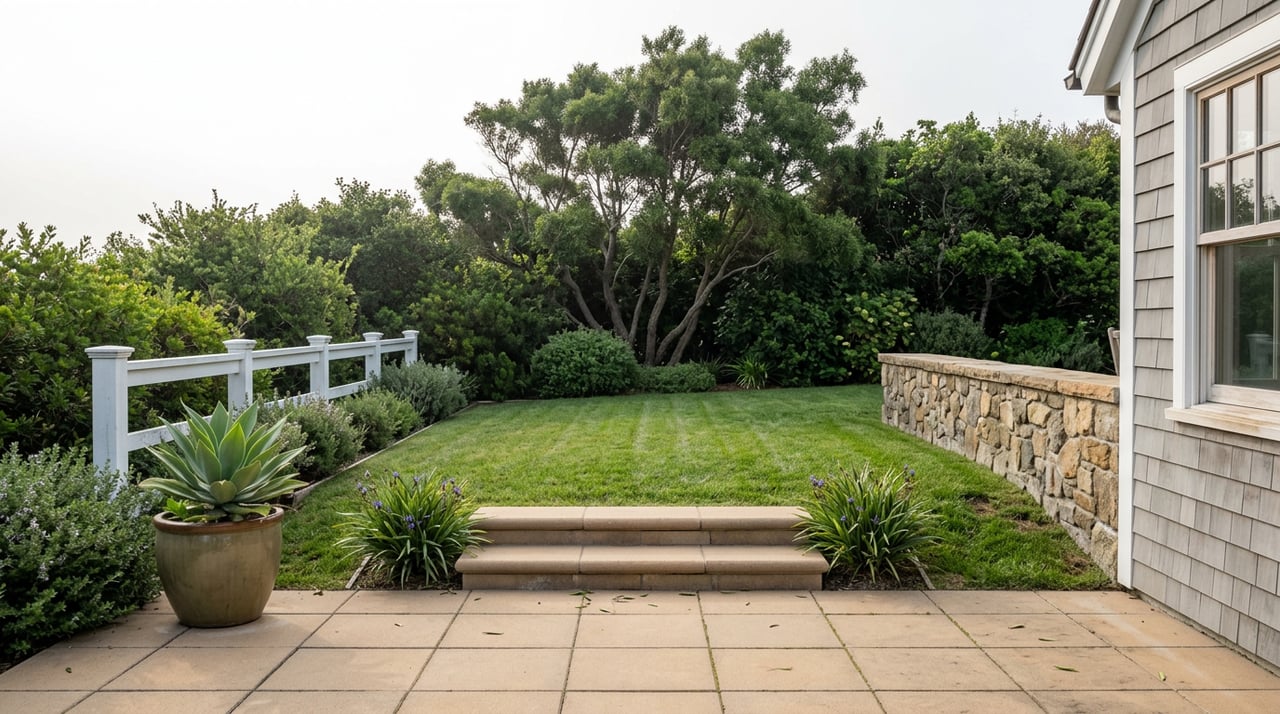
Stand at the Dirt Farm on a clear afternoon and you can trace the coastline from Capitola to Monterey, fog permitting. There is nothing there to look at except three palm trees, a few benches, and open sandstone. That is the entire point. Jack O'Neill bought the lot next to his own house on East Cliff Drive decades ago and left it alone on purpose, a patch of undeveloped bluff between 37th and 38th avenues that the neighborhood has treated as commons ever since, even though the underlying parcel is technically owned by the county.
This year, that emptiness became the subject of a genuine local fight, and the way it ended tells you more about how Pleasure Point actually operates than any zoning map could.
A statue with 78 percent support still didn't get built here
In December, longtime resident Kari Lochhead filed a permit application for a bronze statue of a female surfer, sized to match the 18-foot male surfer that has stood on West Cliff Drive since 1992. The idea had real momentum. Sculptors Brian Curtis and Thomas Marsh, the same pair who made the original West Cliff statue, signed on. Kaila Pearson, daughter of local shaper Bob Pearson, spoke in favor. County Supervisor Manu Koenig backed it publicly and ran an online poll that came back with support from a large majority of respondents.
None of that was enough to get it built at the Dirt Farm.
The poll numbers are worth sitting with, because they explain the outcome better than "neighborhood opposition" does. Koenig's office reported 668 responses, but only 259 addresses could actually be verified, and the early version of the survey never mentioned the statue's height or how much paving the base would require. When residents figured out the scale involved, roughly 16 to 18 feet with a plaza of curved benches, on one of the last stretches of unpaved cliff on the east side, the calculus changed. A community meeting at Simpkins Family Swim Center in March drew about sixty people. Most of them liked the statue. Almost none of them wanted it on that particular patch of dirt.
By late April, a Pleasure Point resident named Nikki Hotvedt had turned that sentiment into an organized push, going door to door around the Dirt Farm and telling neighbors plainly what was at stake: "Once it's gone, it's gone." Her petition and the broader pushback moved the project to an appeal before the planning commission in May. Rather than fight it out to a final vote, Lochhead pulled the application and went looking for a new home.
Why Capitola said yes almost immediately
She found one just down the coast. In May, the project announced it would relocate to Capitola Esplanade, and the reception there was close to instant enthusiasm. Capitola Vice Mayor Gerry Jensen had followed the saga and welcomed the idea the moment Lochhead reached out. The timing lined up too: Capitola's surf breaks had just been added to the Santa Cruz World Surfing Reserve in 2025, extending the protected zone to roughly seven miles of coastline, and the village already hosts the annual Women on Waves competition each October. A statue honoring women in surfing fit a place that had just built its public identity around exactly that.
The two statues will now bookend the Reserve, the male figure at West Cliff and the female figure eventually at Capitola, framing the same coastline from opposite ends without either landing at the Dirt Farm at all.
That contrast is the real story here. Two neighborhoods that outsiders often lump together, separated by little more than a few blocks of East Cliff Drive, drew the line in completely different places. Capitola said yes to adding a landmark to a village that already trades on movie nights, festivals, and public gathering space. Pleasure Point said no to placing anything permanent on the one parcel it has spent decades keeping empty.
This wasn't the first time
If you have lived here more than a few years, none of this should feel like an isolated fight. The same instinct has shown up repeatedly along the Portola Drive corridor, just usually about buildings instead of bronze:
- In 2016, a mixed-use proposal for the old lumberyard at 38th and Portola, which would have added a coffeehouse, artisan booths, and condos, drew enough neighborhood pushback that it never got built. The lumberyard largely sits as it did.
- The advocacy group that formed out of that fight, Save Pleasure Point, went on to help stall a hotel proposal at the former Black Pearl Tattoo site across Portola, again largely over parking and scale concerns.
- That same group's most recent update, published in July, shows a revised density proposal for the Pleasure Point Plaza site still under county review, with the group on record opposing an increase in units beyond what was approved back in 2019.
What that update also shows, though, is that Pleasure Point is not reflexively against everything new. The former Opal Cliff Motors and Cliff Café buildings are currently being converted into a full-service restaurant and bar with patio dining and a second-story residential unit, and that project has moved forward without the kind of organized resistance the statue or the lumberyard faced. The distinction seems to be less about growth in general and more about what gets built on land that used to be undeveloped versus land that was already a business.
Even the neighborhood's oldest surf tradition runs on the same logic. Logjam, billed by its organizers as the longest running vintage longboard contest in the world, still requires boards built before 1970 and bans leashes entirely every year it returns to Pleasure Point. The rule isn't nostalgia for its own sake. It is the same preference for keeping a specific, bounded thing exactly as it was, applied to surfboards instead of cliffs.
What this actually means if you live here
None of this is really about art, or hotels, or condos. It is about the fact that Pleasure Point has very little undeveloped land left along East Cliff Drive, and the community has gotten precise about defending what remains of it. A restaurant inside an already-commercial building gets a green light. A 16-to-18-foot statue and paved plaza on the last open bluff does not, no matter how popular the idea is in the abstract.
For anyone who walks that stretch regularly, the practical upshot is simple. The Dirt Farm is staying exactly as it has been for years, dirt, palms, benches, and a view south to Capitola. The statue project is still alive, just down the coast in Capitola, targeting 2027 for installation pending Capitola's own arts commission and city council approvals. And the next time a new proposal shows up on a mailer or a sign stapled to a palm tree along East Cliff, you now have a better read on how this particular stretch of coastline tends to answer.
If you are weighing what a piece of this coastline is actually worth, from the parcels along East Cliff to the commercial corridor on Portola, the Lyng-Vidrine Team has spent years reading exactly these kinds of local shifts. Show me how much my coastal home can sell for.